
AI and Data Centres: another industrial revolution?


The number of artificial intelligence (AI) data centres being constructed in the United States is growing at an incredible pace, with business leaders like Brookfield CEO, Bruce Platt, saying that they can’t be built quick enough. But, as each new data centre goes up, there appears to be an increasing resistance to these operations.
AI data centres require enormous amounts of power to drive them, and even more water to cool the tightly-packed processing units.
Recently, a group of over 300 residents in Danville, Pennsylvania, attended a rural Pennsylvania planning commission meeting to voice their concerns over the proposed construction of an AI data centre in their county.
Residents, farmers and environmentalists around the world are concerned about the impact AI data centres have on the surrounding environment, with the facilities using incredibly large amounts of water, while also driving electricity prices up through the sudden increase in demand after a data centre is up and operational.
Goldman Sachs have stated that global electricity prices could rise 165% by 2030 due to the increase in number of AI data centres.
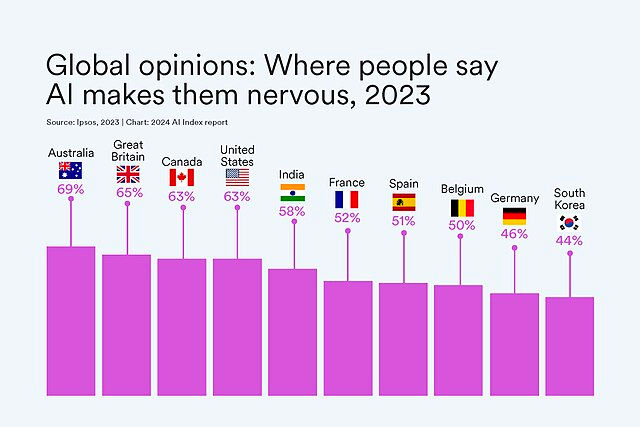
A country-by-country study from Stanford University looked at the percentage of a nations population that were nervous about the implications of AI. The study revealed that Australians topped the list at 69%, with Great Britain (65%) and Canada (63%) following. (See chart).
While communities have become increasingly concerned by the number of AI data centres and the requirements to run them, others speak of a reality that is driven by the major players (technology and energy companies) in the market, but also fuelled by the populations seemingly unquenchable thirst for data-heavy services, such as streaming outlets, social media platforms, and now, AI-driven chatbots, such as ChatGPT.
In terms of importance to global economies, some commentators are calling data, the new oil.
It is a fact of modern-day life that a quick scan of your surroundings in any built-up area will reveal individuals disconnected from those surroundings and the people they are either sitting next to, or passing closely by. Their eyes are fixed to a screen while their thumb quickly moves back-and-forth to reveal a new image. Those not looking at a screen have their ears encased in large headphones: equally disconnected from those around them.
Apart from the desire (or trained response) of the average consumer to consume more data, and at a faster rate than ever, the number of AI data centres being constructed is also driven by the need for business and governments, along with their respective departments, including defence, to stay up-to-speed with their competitors.
When interviewed by MSNBC, Platt said that: “The countries of the world used to build roads and railways, and today what they need to build is AI data centres…”
He continued by stating that if you do not have these facilities in your country, as energy consuming as they might be, companies will leave to do business elsewhere. As a result, the jobs they provide will also disappear.
The Trump administration has made AI data centres and their supporting infrastructure a national priority. A recent $80 billion partnership between the US Government and several large corporations to build nuclear reactors within the US that will power the data centres, illustrating the importance in which AI data centres are placed within government policy.
With the US Government stating that it will effectively fast-track any AI data centre project with a $500 million-plus budget, citizens like those in Danville, Pennsylvania, could rightly feel like they are fighting a losing battle.
The AI Explosion
Artificial intelligence, and artificial general intelligence (AGI), are terms that the average person has become accustomed to. We may have a very limited understanding of it, but we are aware that is impacting our lives. What many of us probably do not fully appreciate, is how much it impacts our lives, and the speed in which it is developing.
An obvious example, is that AI could have written this for me, but I choose to do it myself; but this is an elementary example, and while we pause to consider how AI can write a letter, create a video, or even a film, the technology has leapt ahead to a place that is getting us closer to resembling peasants in a medieval village; working, but practically defenceless against the whim of a powerful lord.

Data centres have been around for some time, but they were generally contained within the business itself; a couple of rooms in the basement, or some other out-of-the-way, but convenient space. With the advancement of the internet and the need for more data storage, these rooms became independent buildings, the size of large warehouses.
But as a large as these traditional data centres were, the difference between them and what is required by AI is enormous in terms of chip capacity and the energy needed to run them.
For example, the 10 megawatts of critical infrastructure power needed for a traditional data centre, was quickly overshadowed by the increasing demands of Google, Microsoft and Meta etc, when they began building facilities requiring 40-100 megawatts of critical infrastructure power.
Now, AI data centres need 200 megawatts, with that figure likely to be outdated quickly.
To further illustrate the speed of change, the rate in which this technology has advanced, and the amount of potential profit involved, has seen large companies scrap multi-million-dollar projects that were midway through, but using outdated technology, in order to realise that long-term profit.
The graphic processing unit (GPU) performs complex computations at speeds much faster than the older CPU’s that were the core of our familiar desk-top computers and other devices.
GPU’s and GPU clusters, which are essential to AI training, are placed in ever-increasing numbers on server racks in data centres. These GPU clusters are developing quickly in terms of their capacity; increasing the efficiency of AI data centres, but also dramatically increasing the power requirements.
The use of more power, causes more heat around the units, which in-turn has seen data centres move to the use of water as the cooling agent. Traditional data centres used air-cooling.
These factors have led to the aforementioned pushback from sections of the community, especially when data centres impact on rivers and farmland.
While rural areas are feeling the impact of data centres, these facilities are generally concentrated around cities.
In the US, the largest concentration of data centres is in northern Virginia, while on a global scale, Germany and the United Kingdom sit second and third respectively, in terms of total number of AI data centres, with many other nations racing to increase their data centre capacity.
It is perhaps why Frank Holmes in an article for Forbes, said that the emergence of AI and the rate of data construction: “…is a full-blown industrial revolution.”


Comments